Open-Source APM Selection Guide: SkyWalking or OpenTelemetry
SkyWalking · Open-Source APM · OpenTelemetry · DataBuff · Distributed Tracing
摘要:Summary: As OpenTelemetry pushes a unified standard, teams already on SkyWalking often wonder: double down or try OTLP in parallel? This article provides a five-dimension evaluation checklist, a three-phase coexistence path, and 30-minute POC acceptance criteria—turning selection slogans into verifiable actions. Read through before deciding whether to keep SkyWalking or open a new line.
Covers architecture highlights, the five-dimension checklist, and parallel POC screenshots—ready for a technical committee review.
This article does not argue about "who is better." It starts by aligning on selection mindset: parallel evaluation does not mean immediate replacement. Then it walks through the five-dimension checklist to compare SkyWalking and OpenTelemetry routes, lands a three-phase coexistence path, and adds a scenario match table plus 30-minute POC steps. By the end, you can turn vague committee debates into an actionable checklist.
1Align on Mindset: Selection ≠ Replacement
SkyWalking remains a mature open-source APM; much "selection anxiety" comes from OTel strategy, not sudden product obsolescence
Technical committees often swing between two extremes: "never change what we have" or "migrate everything at once." The safer practice is parallel evaluation—keep SkyWalking serving existing probes while new services or OTel-ready workloads connect to another backend, then compare real traces and metrics side by side.
Frame the selection goal as: "Over the next 12 months, can we handle OTel unified ingestion at lower operational cost and add AI-assisted troubleshooting?"—not "Is SkyWalking good enough?"
If ≥2 items on the five-dimension checklist strongly match your strategy (e.g., OTel as the sole standard + AI Q&A), spend an afternoon on a parallel POC. If none match, deepening SkyWalking is equally reasonable.
◆ ◆ ◆
2Five-Dimension Evaluation Checklist
Use directly in architecture reviews; each row includes typical SkyWalking behavior and what to watch during parallel evaluation
| Dimension | Key Question | Typical SkyWalking Behavior | Parallel Evaluation Focus (DataBuff example) |
|---|---|---|---|
| ① OTel Strategy | Must the app side maintain only one OTel SDK? | Multiple probe formats + OTLP receiver (OAP 11800/12800) | Is OTLP the only ingress; do gRPC 4317 / HTTP 4318 align with Collector plans |
| ② Operational Surface | Who maintains storage and ingestion day to day? | OAP + Storage (ES/BanyanDB, etc.) + UI—many components | Can it collapse to Ingest + Doris + Web; does Demo run on 8G |
| ③ AI Troubleshooting | Need conversational Trace/metric queries? | AI Pipeline (ML baselines/URI recognition), not conversational APM | AI-native Q&A, multi-agent patrol, MCP in IDE |
| ④ Onboarding & POC Cost | How fast can you prove "traces are queryable"? | Mature Docker/Helm; storage choice takes time | One curl / bash to stand up; Web default 27403 |
| ⑤ Team Skills | Dev self-ops or dedicated SRE? | Suits complex stacks with observability specialists | Suits dev-led teams wanting minute-level validation |
◆ ◆ ◆
3Three-Phase Parallel Path
A standard cadence to reduce psychological and engineering risk
In Phase 2, use Collector config: one receiver, multiple exporters—no app code changes, only Collector routing.
If you cannot decommission SkyWalking yet, Phase 3 can become "dual data plane + unified AI entry": DataBuff queries SkyWalking Open API via Remote MCP, with all conversation in one Web console.
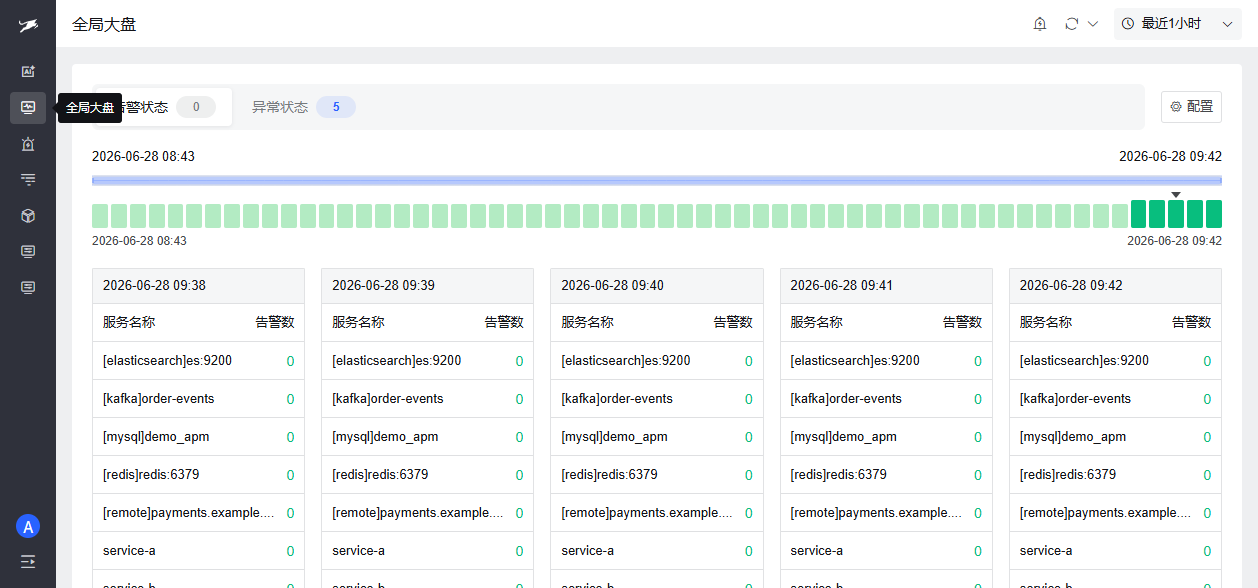
Fig. 1 · During comparison, use the global dashboard to observe service alerts and health side by side, reducing UI switching
Fig. 1 · During comparison, use the global dashboard to observe service alerts and health side by side, reducing UI switching
◆ ◆ ◆
4Scenario Match: When a POC Is Worth It
| Your Situation | Recommendation | Rationale |
|---|---|---|
| Company pushing OpenTelemetry as the unified standard | Parallel POC | Verify an OTLP-native backend can serve new services |
| OAP + ES ops burden, no dedicated SRE | Parallel POC | Compare day-to-day ops of a three-component stack |
| Want natural-language Trace queries, exploring AI ops | Parallel POC | Experience AI-native Q&A and MCP workflows |
| Heavy Mesh/eBPF, full four-pillar stack | Stay on SkyWalking | Zero-code infrastructure coverage remains a core strength |
| Stable legacy agents, no OTel roadmap | Wait and see | No migration driver—don't change for change's sake |
◆ ◆ ◆
5Parallel POC: Validation in 30 Minutes
Selection conclusions should come from reproducible environments, not slides
DataBuff provides a public one-line install script (requires Docker, ~8G RAM):
After install:
Web UI: http://<host>:27403OTLP gRPC: 4317 OTLP HTTP: 4318 (e.g. /v1/traces)
POC acceptance checklist (suggested):
At least one service appears in the service list with RED metrics Global topology shows call edges Trace list filters slow requests and drills into Spans (Optional) AI Q&A returns answers grounded in real data
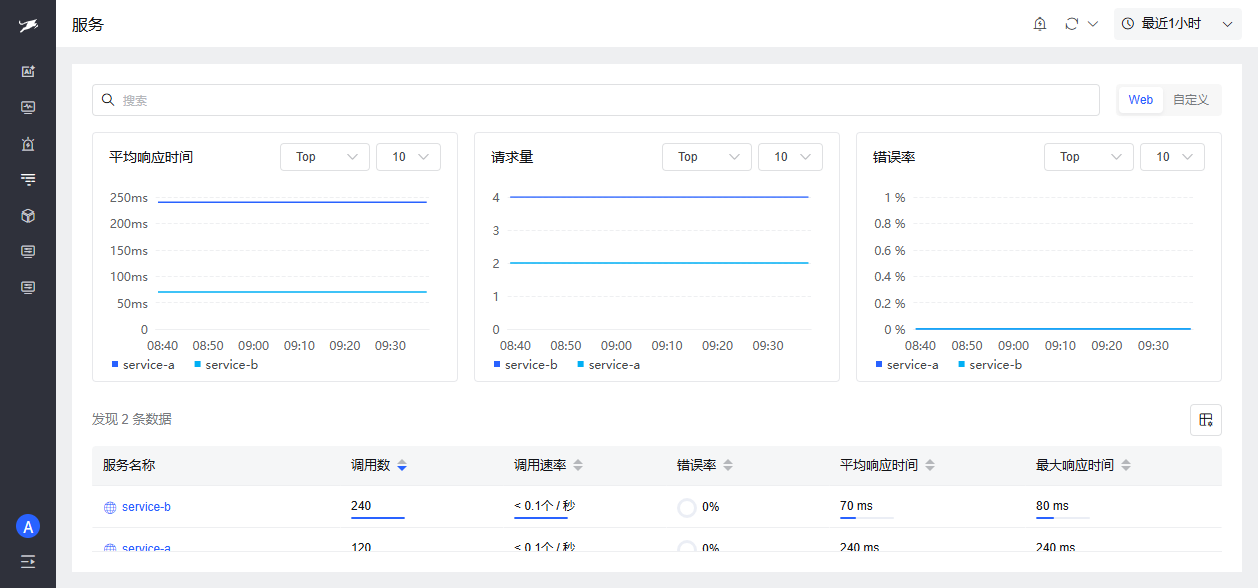
Fig. 2 · Acceptance ①: service list should show OTel-reported services with readable request volume / error rate / avg response time trends
Fig. 2 · Acceptance ①: service list should show OTel-reported services with readable request volume / error rate / avg response time trends
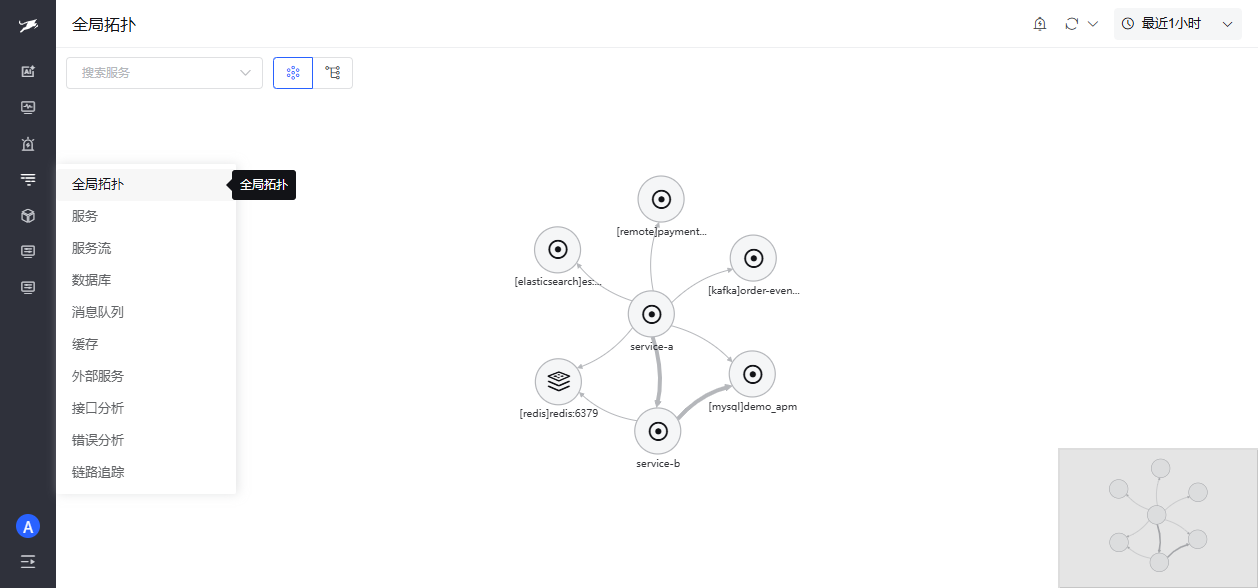
Fig. 3 · Acceptance ②: global topology should show inter-service call edges and middleware nodes such as MySQL, Redis, Kafka
Fig. 3 · Acceptance ②: global topology should show inter-service call edges and middleware nodes such as MySQL, Redis, Kafka
◆ ◆ ◆
6FAQ
| Question | Short Answer |
|---|---|
| Already on SkyWalking—must we migrate immediately? | No. Use the five-dimension checklist to assess gaps, then run a parallel POC to validate OTLP ingestion and end-to-end tracing. |
| Can SkyWalking coexist with OTel-based APM? | Yes. Collector dual export or Remote MCP for legacy SkyWalking; new traffic via OTLP 4317/4318. |
| Which dimension should we check first? | OTel strategy alignment—whether the app side wants to maintain only one SDK/Exporter. |
◆ ◆ ◆
From an industry perspective, Gartner views observability platform investment as a way to avoid revenue loss from critical digital business failures and to improve availability and resilience. SkyWalking selection need not be binary—a five-dimension parallel POC is a lightweight way to "validate vendors by business outcomes" in Gartner's sense.
◆ ◆ ◆
7References
[1] : https://skywalking.apache.org/docs/main/latest/en/concepts-and-designs/overview/ [2] : https://skywalking.apache.org/docs/main/latest/en/setup/backend/otlp-trace/ [3] : https://opentelemetry.io/docs/specs/otlp/ [4] : https://skywalking.apache.org/docs/main/next/en/setup/ai-pipeline/introduction/ [5] : https://opentelemetry.io/docs/collector/configuration/ [6] : https://github.com/databufflabs/databuff?utm_source=article&utm_medium=web&utm_campaign=viral-01 [7] : https://databuff.ai/databuff/ai-apm-install.sh [8] : https://www.gartner.com/reviews/market/observability-platforms
◆ ◆ ◆
◆ ◆ ◆