A Stronger Backend for SkyWalking
SkyWalking · DataBuff · AI APM · 11800
Many ops teams already run SkyWalking Agents. The hard part is often the backend—how to deploy it, and how deep troubleshooting can go. DataBuff can ingest native SkyWalking gRPC. Change the collector address, then try AI Q&A, waterfall traces, and global topology.
SkyWalking is common in China: rich probes, solid docs, a clear onboarding path.
What usually hurts is not the Agent—it is backend setup and how deep on-call analysis can go.
Bottlenecks show up later: OAP deployment, storage choices, UI depth for incidents, and whether AI can turn natural-language questions into inspections and diagnoses.
That is why DataBuff matters here: it can take over SkyWalking Agent traffic.
Keep the Agent. Swap the backend. That is what this article walks through.
◆ ◆ ◆
1Connect: just change the backend address
Docs are clear: Trace, JVM metrics, and Log gRPC all go to Ingest port 11800.
Minimum config is two lines:
Attach the javaagent at startup:
System properties work too:
OTLP can coexist: SkyWalking uses 11800; OTLP stays on 4317 / 4318.
After connecting, verify services and traces appear in the Web UI—or try the public Demo first.
◆ ◆ ◆
2What the new backend looks like
Connection is step one. The real test: can on-call skip a few menu hops?
01 · AI Q&A: ask for the service inventory in plain language
Ask: "List services in the last hour."
You get categorized tables—business services, DBs, cache/MQ, remote calls—not empty chat.
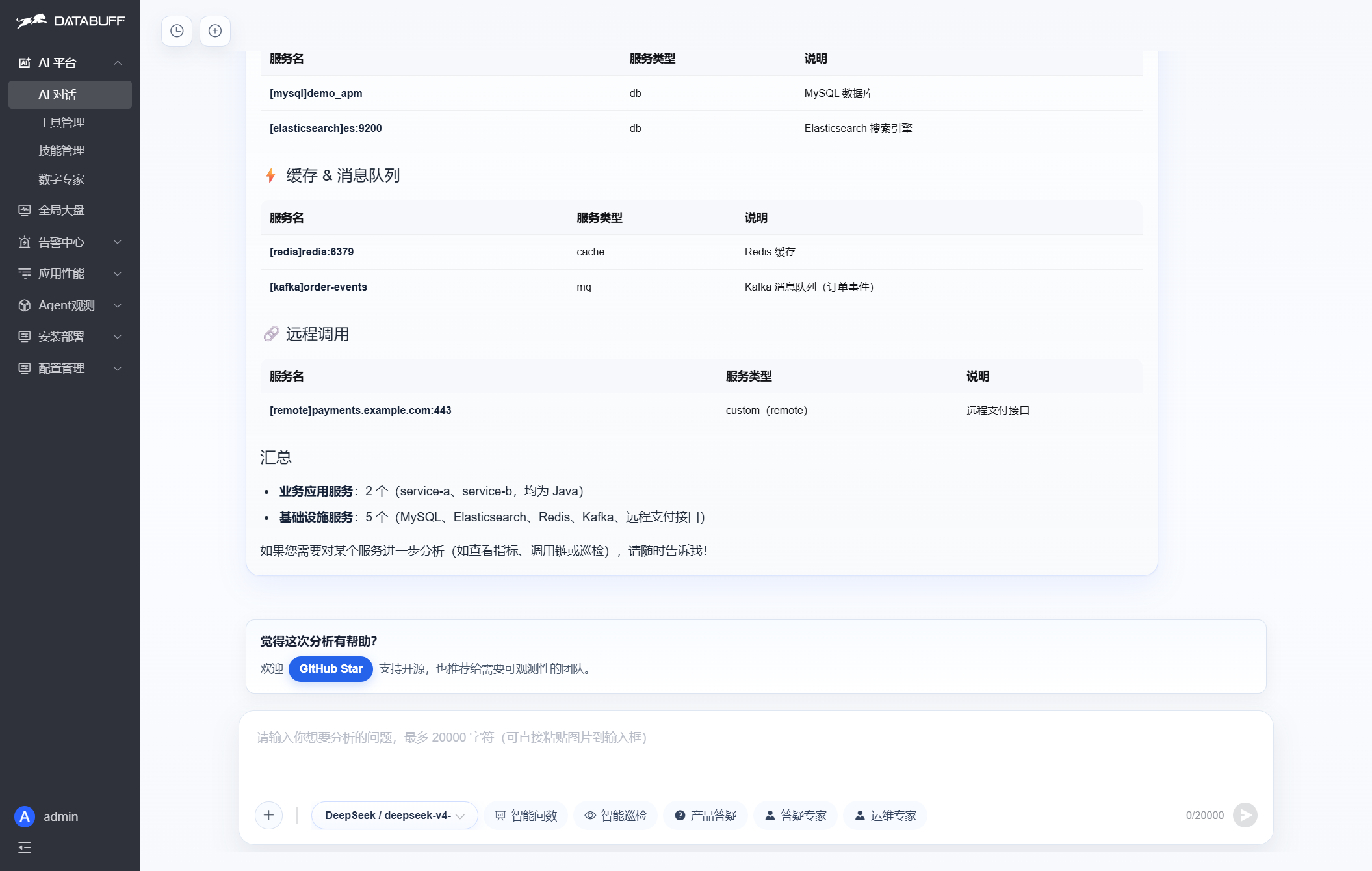
AI Q&A: last-hour service list categorized by business / DB / cache-MQ / remote calls.
02 · Trace detail: waterfall spreads latency
Open a call chain: entry GET /demo/checkout on service-a, about 240ms total.
Redis, HTTP, MySQL, ES, Dubbo, Kafka Spans line up—who eats time is obvious.
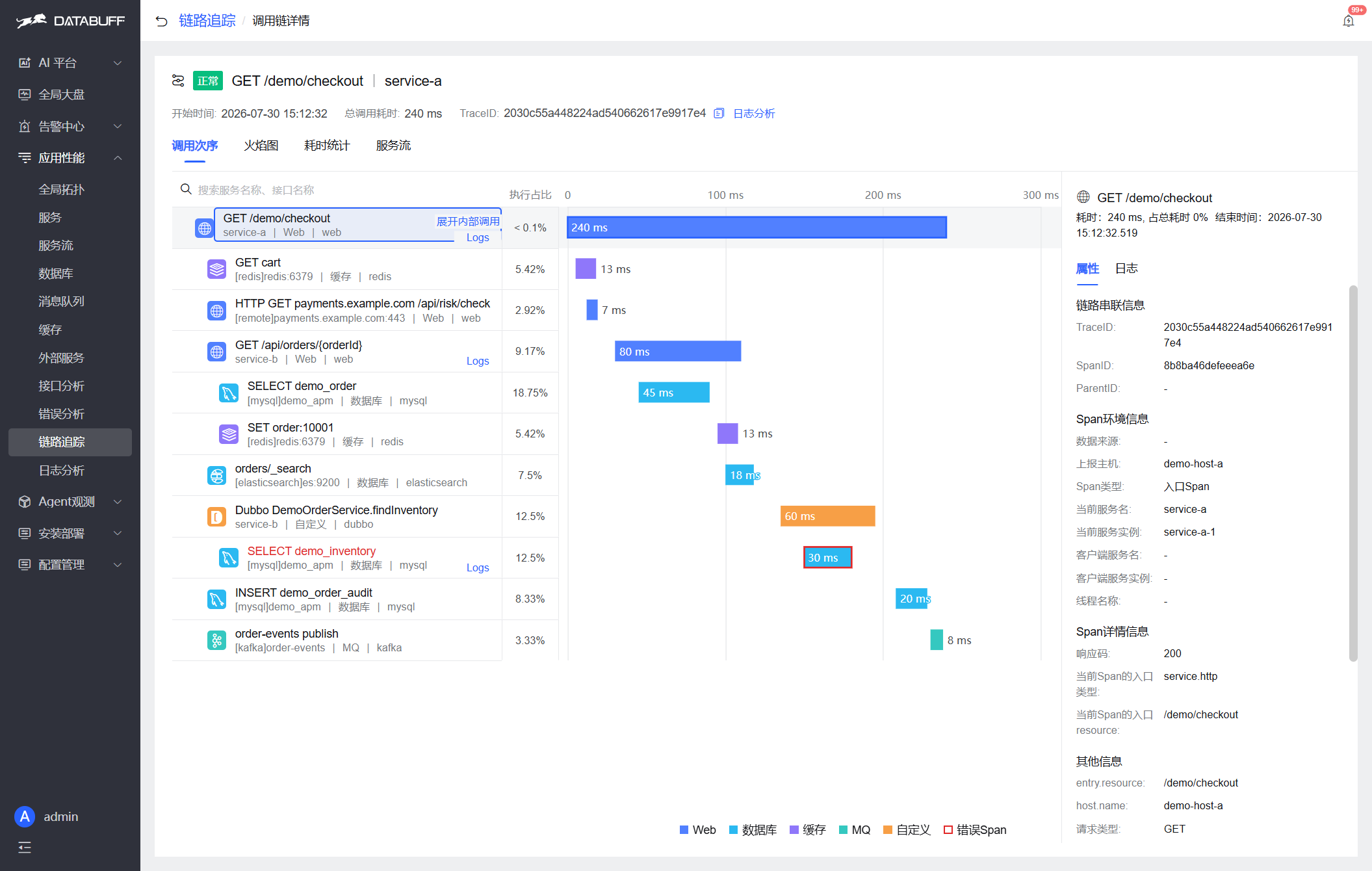
Trace detail: GET /demo/checkout ~240ms; waterfall shows Redis / MySQL / Dubbo / Kafka Spans.
03 · Global topology: who talks to whom
service-a, service-b, then MySQL, ES, Redis, Kafka, remote payment—on one map.
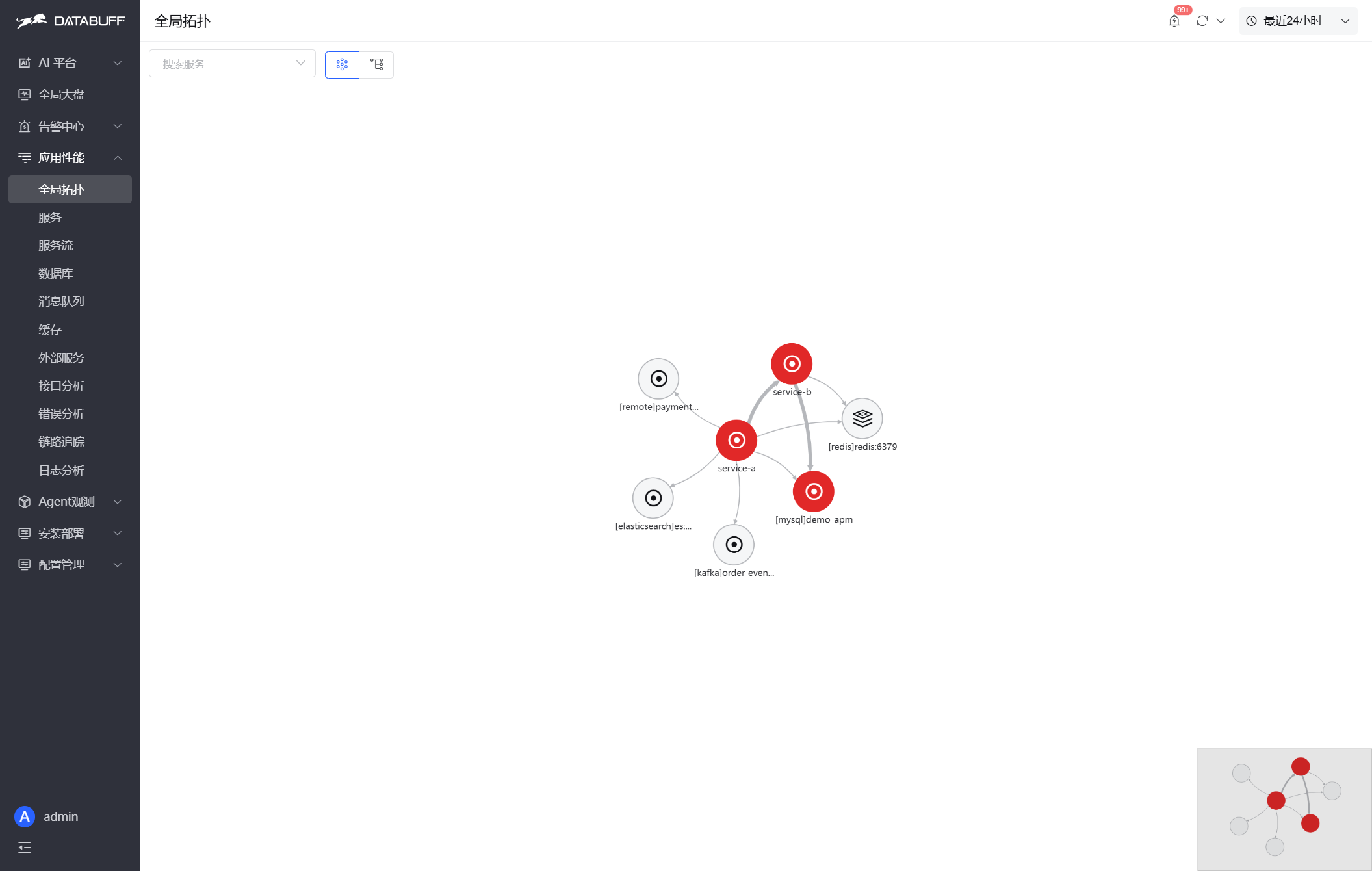
Global topology: service-a / service-b and dependencies on MySQL, ES, Redis, Kafka, remote payment.
Three passes: inventory → one request → global map. Same Agent, deeper backend.
◆ ◆ ◆
3Close: compare objectively
Basics overlap: topology, services, Trace, logs—both SkyWalking and DataBuff cover them.
DataBuff adds mainly the AI layer—plus deeper call analysis from edge to Trace.
If you already run many SkyWalking Agents and want AI + APM pages first: retarget and try.
Not replacing SkyWalking—keeping probes while making the backend stronger.
◆ ◆ ◆
4Industry view: observability is moving toward AI
Gartner's Observability Platforms research puts it plainly: platforms turn telemetry into insight and action via analytics, visualization, automation—and increasingly AI.
The same thread shows up in coverage: not only metrics/logs/traces, but AI/ML for anomalies, noise reduction, root-cause correlation, and AI observability for GenAI workloads.
Another oft-cited forecast: by 2028, about 40% of organizations deploying AI will use dedicated AI observability to watch model performance, bias, and outputs.
For SkyWalking / DataBuff: keeping Agents while adding AI Q&A and deeper traces aligns with that direction—not a gimmick.
◆ ◆ ◆
5References
1. Gartner Magic Quadrant for Observability Platforms — https://www.gartner.com/en/documents/5663323
2. Network World on Gartner AI capabilities in observability — https://www.networkworld.com/article/4032218/in-crowded-observability-market-gartner-calls-out-ai-capabilities-cost-optimization-devops-integration.html
3. Gartner: ~40% of AI-deploying orgs to use AI observability by 2028 (via APMdigest) — https://www.apmdigest.com/gartner-40-organizations-deploying-ai-will-use-ai-observability-monitor-model-performance-2028
4. https://databuff.ai/docs/zh/manual/skywalking-ingestion
5. https://databuff.ai/docs/zh/comparison/databuff-vs-skywalking
6. https://github.com/databufflabs/databuff
7. https://demo.databuff.ai/
8. https://www.databuff.ai/
◆ ◆ ◆