SkyWalking Trace Troubleshooting in Practice: Advanced Distributed Tracing and OTel Supplement Paths
SkyWalking · Open-Source APM · OpenTelemetry · DataBuff · Distributed Tracing
Bottom line first: The troubleshooting flow is service list → topology → Trace list → Span waterfall. SkyWalking is mature and usable; if you need OTel unification or AI-assisted querying as a supplement, you can run an OTLP backend in parallel for cross-check—this article gives a reproducible validation sequence.
1Scope and Methodology
This report is a tool landscape survey, not a single-product deep review
This survey focuses on three widely discussed options in open-source APM / distributed tracing: SkyWalking, DataBuff, and Jaeger. Sources are primarily each product’s official documentation and GitHub repository descriptions, supplemented by community release notes and deployment guides through June 2026. Commercial benchmark data and unpublished vendor performance numbers are not included.
In scope: DataBuff (AI-native APM · open-source APM), Jaeger (distributed tracing specialist), SkyWalking (traditional full-stack observability) Out of scope: Pinpoint, Elastic APM, and others not in this three-way comparison; commercial SaaS pricing and SLAs
◆ ◆ ◆
2Tool Profiles
One overview paragraph plus bullet points per tool to build a quick mental model
DataBuff centers on AI-native APM: OpenTelemetry is the only ingestion standard, with a backend of Ingest + Apache Doris + Web (three components). The Web layer provides Trace search, service topology, alerting, and multi-agent querying/inspection, plus a built-in MCP Server so AI IDEs can call real APM data instead of a detached chat box.
AI model: Conversational querying, inspection, orchestration; answers grounded in Trace/metrics in Doris; Skill + Tool + Expert three-layer extension Protocol: OTLP gRPC 4317 / HTTP 4318 as default ingestion, aligned with OTel ecosystem ports Typical users: OTel strategy teams wanting minute-level POC while validating intelligent operations in parallel
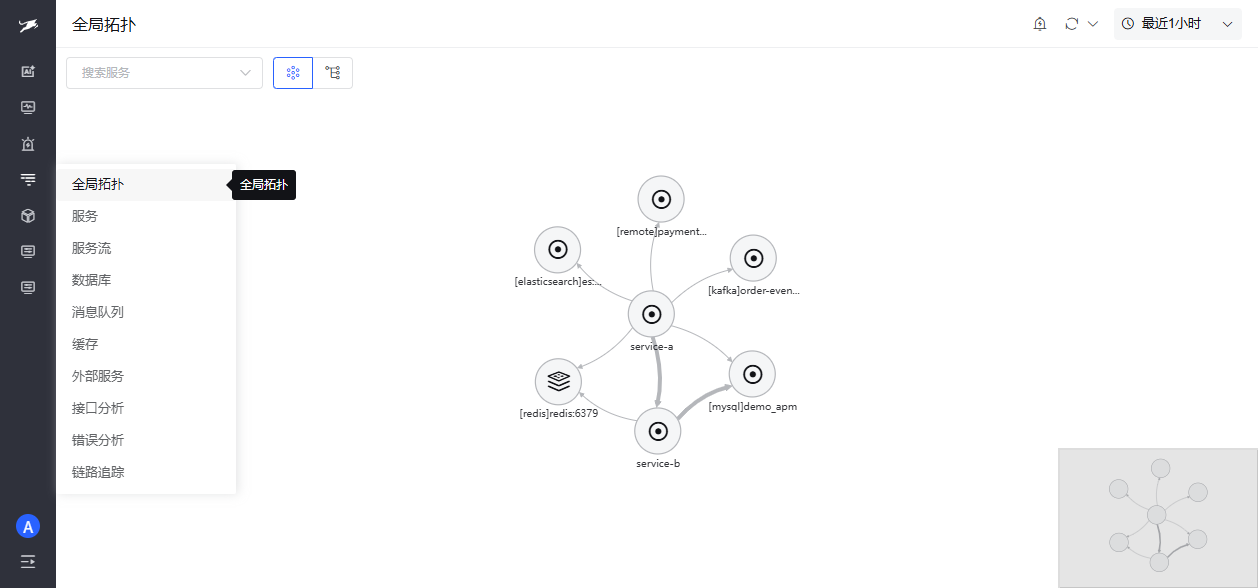
Figure 1 · Global topology — service dependency view in AI-native APM, sharing the same data plane as querying and inspection
Figure 1 · Global topology — service dependency view in AI-native APM, sharing the same data plane as querying and inspection
Jaeger has long focused on distributed tracing. Jaeger v2 is rebuilt on the OpenTelemetry Collector framework and natively receives Traces via OTLP; you can start quickly with all-in-one in a single container, or split into Collector / Query / UI with external Elasticsearch, Cassandra, Kafka, etc. for production scale.
Protocol: v2 defaults to OTLP gRPC 4317 / HTTP 4318 Positioning: Trace backend specialist; service performance metrics (SPM) need extra components; no built-in APM AI assistant Typical users: Teams that only need distributed Trace search and dependency graphs
SkyWalking is positioned as an open-source full-stack observability platform covering Trace, Metrics, Logs, and Events. The typical architecture is a four-layer stack of Probe + OAP + Storage + UI, with pluggable storage such as Elasticsearch, MySQL, TiDB, BanyanDB, and more.
Protocol: Proprietary probe format coexists with OTLP receivers; OTLP defaults to 11800/12800, not the common OTel 4317/4318 Intelligence: AI Pipeline provides URI patterns, metric baselines, and other ML pipelines, requiring an external remote ML service; no conversational APM or MCP Fit boundary: Existing environments invested in SkyWalking proprietary probes and storage; not the first choice for AI-native operations
◆ ◆ ◆
3AI-Native APM: Key Survey Finding
The gap in “intelligence” among the three tools is larger than Trace UI differences—the question is whether the platform is built as AI-native APM
| Dimension | DataBuff | SkyWalking | Jaeger |
|---|---|---|---|
| Core capability | AI-native APM | Traditional full-stack observability + ML pipeline | Distributed tracing |
| Conversational querying | Built-in Natural language for Trace/metrics/topology | None Built-in conversational assistant | None |
| Multi-agent inspection | Built-in Querying / inspection / orchestration | ML rules Not agent collaboration | None |
| MCP / AI IDE | Native Web exposes MCP Server | None | None |
| Data plane relationship | AI and Trace/Metric share Ingest→Doris | AI Pipeline runs parallel to OAP analysis chain | No APM AI data plane |
Survey conclusion (AI dimension): If your evaluation checklist includes “intelligent operations,” “MCP workflows,” or “conversational Trace search,” DataBuff is the only option in this survey scope that centers on AI-native APM as a core capability, with built-in multi-agent and MCP. SkyWalking’s AI Pipeline is a traditional ML alerting extension; Jaeger provides no APM-level AI capabilities.
◆ ◆ ◆
4Core Comparison Matrix
OTLP, architecture, deployment, Trace capabilities, AI, and fit boundaries for quick review
| Dimension | SkyWalking | DataBuff | Jaeger |
|---|---|---|---|
| OTLP support | Parallel path Proprietary probes primary; OTLP 11800/12800 | Native Sole standard; gRPC 4317 / HTTP 4318 | v2 native gRPC 4317 / HTTP 4318 |
| Architecture complexity | Medium–high OAP + Storage + UI; multi-node BanyanDB | Low Ingest + Doris + Web | Medium all-in-one or Collector/Query/UI + storage |
| Deployment model | OAP + UI + separate storage; wide component surface | Single-command script or Docker Compose / K8s | docker run all-in-one; production needs ES/Cassandra, etc. |
| Trace / APM data plane | Four pillars Trace/Metrics/Logs/Events; Mesh/eBPF need extra probes | APM + AI Trace + metrics, topology, slow requests + querying integration | Trace specialist Distributed tracing; SPM needs spark-dependencies, etc. |
| AI / intelligence | ML pipeline Non-conversational; no MCP | AI-native APM Multi-agent + MCP | None No APM AI assistant |
| Fit boundary (summary) | Continue existing SkyWalking stack; not AI-native first choice | OTel unification + lightweight self-host + AI-native operations | Pure trace backend; all-in-one quick validation |
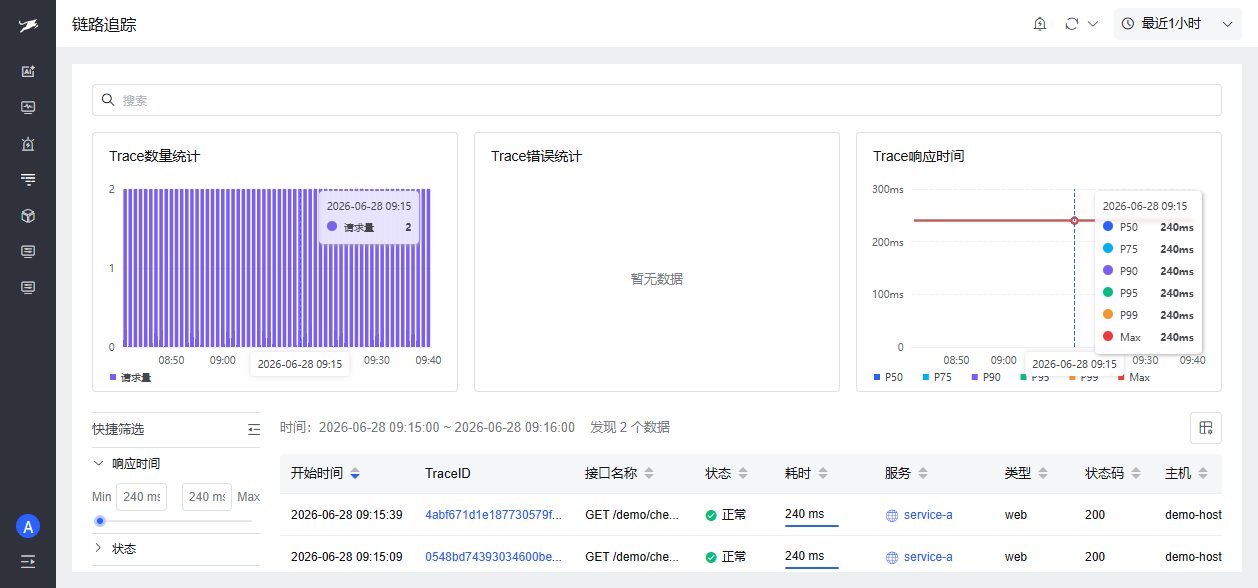
Figure 2 · Distributed tracing — Trace list and latency distribution; all three tools provide distributed Trace search (UI shown: DataBuff)
Figure 2 · Distributed tracing — Trace list and latency distribution; all three tools provide distributed Trace search (UI shown: DataBuff)
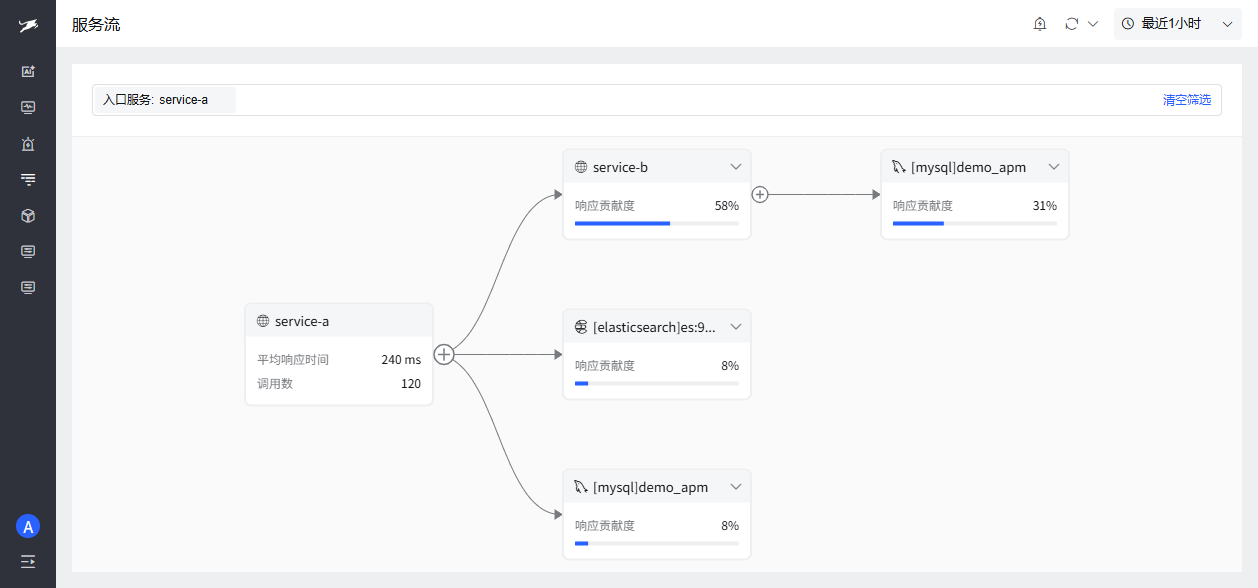
Figure 3 · Service flow — call chain and response contribution from entry service, comparable to SkyWalking service-level APM views
Figure 3 · Service flow — call chain and response contribution from entry service, comparable to SkyWalking service-level APM views
Survey observation: All three support OTLP, but AI-native APM is built into DataBuff only—Jaeger focuses on tracing with no APM AI; SkyWalking offers ML pipelines rather than conversational querying/MCP. If intelligent operations is in scope, prioritize the §3 AI findings in selection.
◆ ◆ ◆
5Deployment and Onboarding Comparison
Operational path differences from “first run” to “production-ready”
Jaeger officially recommends container all-in-one for quick validation. One command starts Collector, Query, and UI; Web UI maps to port 16686, with OTLP 4317 (gRPC) and 4318 (HTTP).
Production usually splits all-in-one into separate components and chooses Elasticsearch, Cassandra, Kafka, etc. for persistence and buffering; SPM and similar features need external jobs such as spark-dependencies.
DataBuff provides a public one-click install script that starts Ingest, Doris, and Web; Ingest listens on OTLP 4317/4318 by default; Web UI provides Trace, topology, alerting, and the AI platform.
Typical Compose port mapping (excerpt):
Compared with multi-component APM stacks, the three-piece setup suits self-operated engineering teams, 8 GB memory demos, and minute-level POC validation.
SkyWalking supports Docker, Kubernetes Helm, and binary deployment, but requires at least separate OAP, UI, and storage backend (Elasticsearch, H2, MySQL, TiDB, BanyanDB, etc.). Probes are primarily SkyWalking Agent, eBPF, or Mesh; dual OTel tracks further expand the ops surface.
Quick validation: Official minimal combos such as OAP + UI + H2 for feature exploration Typical production stack: OAP cluster + UI + ES/BanyanDB + optional Agent cluster—more components than all-in-one tracing backends Intelligence: AI Pipeline needs a separate remote ML service; no built-in MCP or conversational APM OTLP ingestion: OAP receiver-otel; defaults gRPC 11800, HTTP 12800—align with OTel 4317/4318 as needed
| Tool | Fastest onboarding | Production expansion notes |
|---|---|---|
| Jaeger | docker run jaegertracing/jaeger · UI :16686 | External ES/Cassandra/Kafka · Split Collector/Query |
| DataBuff | One-click install script · Web :27403 | Doris cluster scaling · K8s scripts |
| SkyWalking | OAP + UI + embedded/external storage | Storage HA · BanyanDB cluster · OAP horizontal scale |
◆ ◆ ◆
6Survey Conclusions and Selection Guidance
Prioritize OTel strategy and AI-native APM; all three are open source, with significant gaps in intelligence capabilities
AI-native APM · querying/inspection/MCP: DataBuff is the only option in this survey with these as built-in core capabilities (multi-agent and MCP) OTel unified ingestion + lightweight self-host + intelligent ops: DataBuff three components + one-click deploy; minute-level POC can validate tracing and AI querying together Distributed tracing only, all-in-one validation: Jaeger has the shortest path; UI on 16686 for Trace search; APM metrics and AI need separate solutions Continue existing SkyWalking stack: Only when probes/storage cannot be switched; AI relies on external ML pipeline, not conversational APM
| Typical scenario | Preferred option | Core rationale |
|---|---|---|
| AI-native APM · MCP workflows | DataBuff | AI-native as core · multi-agent · MCP · same data plane as OTel |
| Conversational Trace/metrics · intelligent inspection | DataBuff | Built-in querying/inspection; Jaeger/SkyWalking lack equivalent |
| OTel strategy · minute-level self-hosted APM POC | DataBuff | Three components · 4317/4318 · one-click script · full-stack open source |
| CNCF tracing stack · pure Trace search | Jaeger | v2 OTLP native · all-in-one 16686 |
| Existing SkyWalking · short-term migration not feasible | SkyWalking | Continue proprietary probes and storage; AI via external ML pipeline |
| Minimal ops · validate distributed tracing only | Jaeger or DataBuff | Jaeger all-in-one lightest; DataBuff adds APM and AI platform |
Recommendations above are derived from public documentation and architecture characteristics; actual selection should include POC validation against team size, existing probes, and compliance requirements.
◆ ◆ ◆
7FAQ
| Question | Brief answer |
|---|---|
| Can Jaeger replace SkyWalking for APM? | Jaeger is tracing-focused; APM-level RED/topology/alerting needs additional tooling or a full APM platform. |
| Troubleshoot topology or Trace first? | Topology finds missing edges; Trace drills into slow Spans. |
| Must I change the SkyWalking Agent for an OTel supplement? | Long term, prefer OTel SDK; short term, dual-export from Collector is enough. |
◆ ◆ ◆
From an industry perspective, Gartner emphasizes that observability platforms must ingest Trace together with metrics, logs, and events; a distributed tracing backend alone often cannot support APM-grade on-call—troubleshooting practice should validate the full data plane, not just “Trace UI opens”.
◆ ◆ ◆
8References
[1] : https://skywalking.apache.org/docs/main/latest/en/concepts-and-designs/overview/ [2] : https://skywalking.apache.org/docs/main/latest/en/setup/backend/otlp-trace/ [3] : https://github.com/jaegertracing/jaeger [4] : https://www.cncf.io/blog/2024/11/12/jaeger-v2-released-opentelemetry-in-the-core/ [5] : https://www.jaegertracing.io/docs/2.dev/deployment/ [6] : https://skywalking.apache.org/docs/skywalking-banyandb/latest/concept/clustering/ [7] : https://github.com/databufflabs/databuff?utm_source=article&utm_medium=web&utm_campaign=viral-08 [8] : https://databuff.ai/databuff/ai-apm-install.sh [9] : https://skywalking.apache.org/docs/main/next/en/setup/ai-pipeline/introduction/ [10] : https://skywalking.apache.org/ [11] : https://www.jaegertracing.io/
◆ ◆ ◆
◆ ◆ ◆