SkyWalking vs DataBuff: How to Choose Between Two Open-Source APMs
SkyWalking · Open-Source APM · OpenTelemetry · DataBuff · Distributed Tracing
Bottom line: SkyWalking maturely covers Trace/Metrics/Logs/Events; DataBuff excels with an OTLP three-component stack plus AI Q&A/MCP. If your team is pushing OTel unified ingestion or needs conversational troubleshooting, start with DataBuff; if you rely heavily on Mesh/eBPF four-pillar coverage, SkyWalking remains a solid choice—the ten-dimension comparison and decision tree below help you land the decision.
1Product Positioning: Mature Ecosystem vs AI Native
Both are community-driven open-source APM projects, but design philosophy and target scenarios differ clearly
Apache SkyWalking is an Apache Software Foundation top-level project covering Trace, Metrics, Logs, and Events—the four pillars—with a Probe + OAP + Storage + UI four-layer architecture. The community is mature, documentation is comprehensive, and it continues to evolve in Service Mesh (Istio/Envoy), eBPF K8s monitoring, BanyanDB storage, and more.
Protocols: Native probe formats + OTLP receiver (Trace / Logs / Metrics) Community: ASF top-level project with mature docs and case studies Typical users: Teams needing full-stack observability, Mesh/eBPF, large-scale Java microservices
DataBuff is an open-source APM that treats OpenTelemetry as the sole ingestion standard. Architecture is minimal—Ingest + Doris + Web as three core components—with the AI platform designed from day one for "data-driven + multi-agent collaboration," not a bolt-on chat box.
Why more teams are evaluating DataBuff: OTLP unified ingestion, a minimal three-component self-hosted stack, AI-native Q&A, and MCP tooling—the sections below break these down dimension by dimension so you can align quickly during selection.
◆ ◆ ◆
2Protocol & Architecture: OTLP Support and Component Complexity
Both support OTLP, but ingestion philosophy and backend stack complexity differ significantly
| Dimension | DataBuff | SkyWalking |
|---|---|---|
| Ingestion philosophy | OTLP as the sole standard; no proprietary Agent lock-in | Multiple probe formats + OTLP receiver (receiver-otel) |
| OTLP gRPC | 4317 (Ingest default) | 11800 (OAP default, configurable) |
| OTLP HTTP | 4318 (Ingest HTTP + OTLP endpoint) | 12800 (OAP default; OTLP/HTTP since PR #13826) |
| Data types | Trace + Metric cover core APM; service topology and slow-request drill-down out of the box | Trace + Metrics + Logs + Events (four pillars) |
DataBuff Ingest exposes these OTLP ports by default:
SkyWalking OTLP ingestion is documented in the official Trace guide; OTLP/HTTP support is in community PR.
| Layer | DataBuff (3 core components) | SkyWalking (typical production stack) |
|---|---|---|
| Collection | Any OTel SDK / Auto-Instrumentation | SkyWalking Agent / eBPF / Mesh probes |
| Ingest / analysis | Ingest (OTLP + aggregation pipeline) | OAP (Observability Analysis Platform) |
| Storage | Apache Doris (unified Trace + metrics storage) | ES / H2 / MySQL / TiDB / BanyanDB, etc.—pluggable |
| Platform / UI | Web (query + alerts + AI + MCP) | SkyWalking UI + optional BanyanDB cluster nodes |
In a typical Docker Compose deployment, three externally exposed service containers (Doris FE/BE as storage; Ingest + Web as application layer) map ports as follows:
Resource threshold comparison vs typical multi-component APM (not benchmark data—for selection reference):
| Metric | Traditional multi-component APM | DataBuff |
|---|---|---|
| Deploy components | 10+ | 3 |
| Minimum memory | 16G+ | 8G runnable (Demo / dev validation) |
| Time to first value | Days | Minutes (one-line install script) |
SkyWalking BanyanDB cluster architecture is in the official Clustering docs.
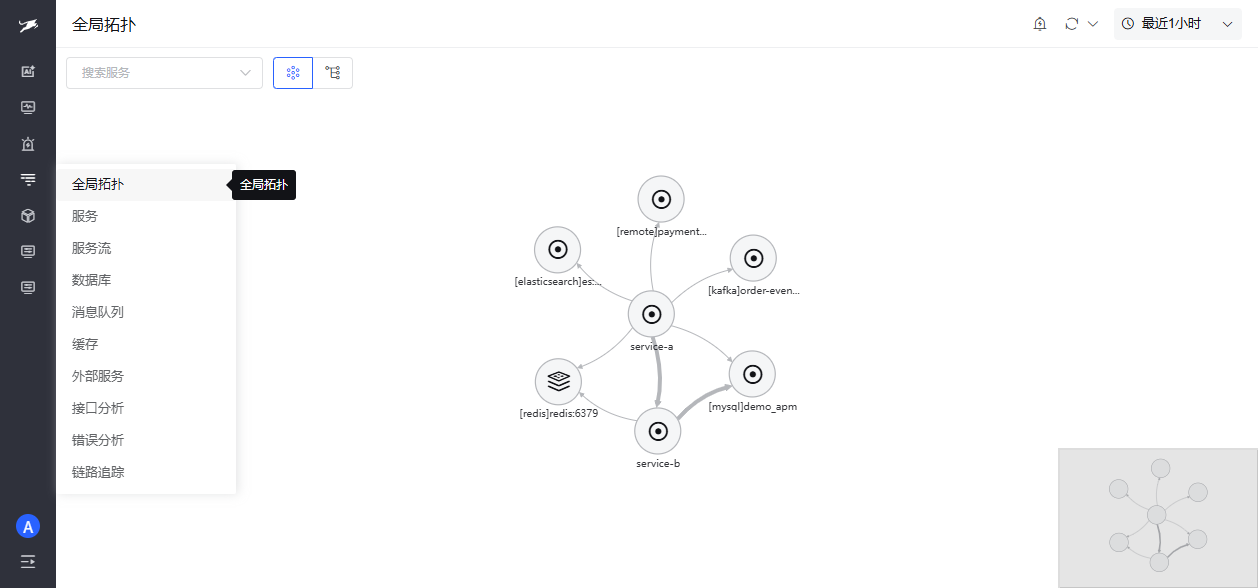
Fig. 1 · After OTLP ingestion, global topology auto-draws service-a → service-b and dependency edges to MySQL / Redis / Kafka—comparable to SkyWalking topology
Fig. 1 · After OTLP ingestion, global topology auto-draws service-a → service-b and dependency edges to MySQL / Redis / Kafka—comparable to SkyWalking topology
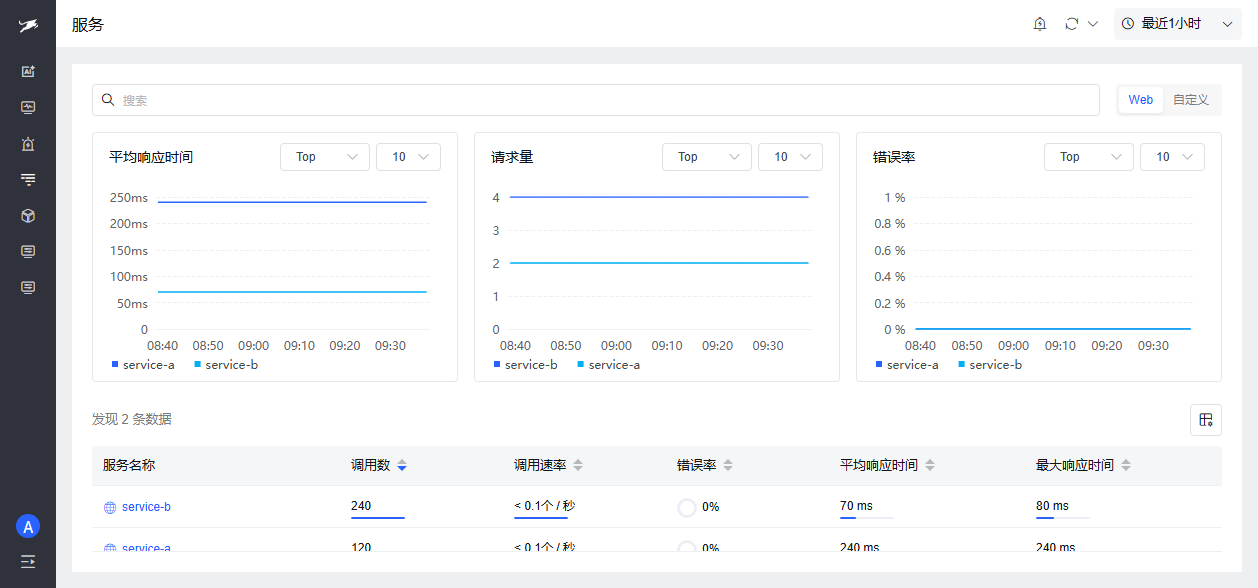
Fig. 2 · Service list ships with RED metrics (request volume, error rate, avg response time)—no extra Dashboard config
Fig. 2 · Service list ships with RED metrics (request volume, error rate, avg response time)—no extra Dashboard config
◆ ◆ ◆
3AI Capabilities: Conversational APM vs ML Pipeline
This is where the two differ most—not "whether AI exists," but how deeply AI fuses with APM data
| Capability | DataBuff | SkyWalking |
|---|---|---|
| AI paradigm | AI native Multi-agent (Q&A / patrol / orchestration); answers must be grounded in real Doris data | ML pipeline AI Pipeline: URI pattern recognition, metric baseline alerts; requires external remote gRPC ML service |
| Conversational queries | Natural language for error rates, Trace trends, service topology | No built-in conversational APM assistant |
| Extension framework | Skill + Tool + Expert layers; AgentScope 2.0 | AI Pipeline rules + remote ML service config |
| MCP integration | Native Platform exposes MCP Server; can register SkyWalking etc. as remote MCP | None No official MCP integration docs found |
| LLM Agent observability | Roadmap Token / tool-chain topology for AI application observability | AI Pipeline targets URI/baselines, not LLM Agent observability |
DataBuff Web embeds an MCP Server exposing APM query tools:
During transition, Remote MCP can connect SkyWalking to DataBuff AI conversation (supports SkyWalking Open API):
SkyWalking AI Pipeline capabilities are in the official Introduction.
OTel logs — OTLP Logs ingestion, linking logs with Traces Agent observability — LLM call chains, Token, tool-call tracing eBPF zero-instrumentation APM — K8s infrastructure observability enhancement
◆ ◆ ◆
4Deployment, Operations, and Selection Cost
Hidden cost of self-hosted APM is often not licensing but component ops and team fit
| Dimension | DataBuff | SkyWalking |
|---|---|---|
| Quick start | curl -fsSL https://databuff.ai/databuff/ai-apm-install.sh / bash | Docker / K8s Helm / binary; storage needs separate selection and deployment |
| Typical production stack | Ingest + Doris FE/BE + Web (3-piece set) | OAP + UI + ES/BanyanDB/MySQL, etc. + optional Agent cluster |
| Storage engine | Apache Doris unified Trace + metrics | Multiple options; BanyanDB is SkyWalking 10+ native time-series/Trace storage |
One-line install script (public).
Deployment experience gap: DataBuff uses a three-component + one-line script approach to bring self-hosted APM to minutes—devs can self-operate and quickly validate OTel + AI-native capabilities. SkyWalking covers more surface area and typically needs more components and storage choices—better suited to teams with dedicated SRE for complex stacks.
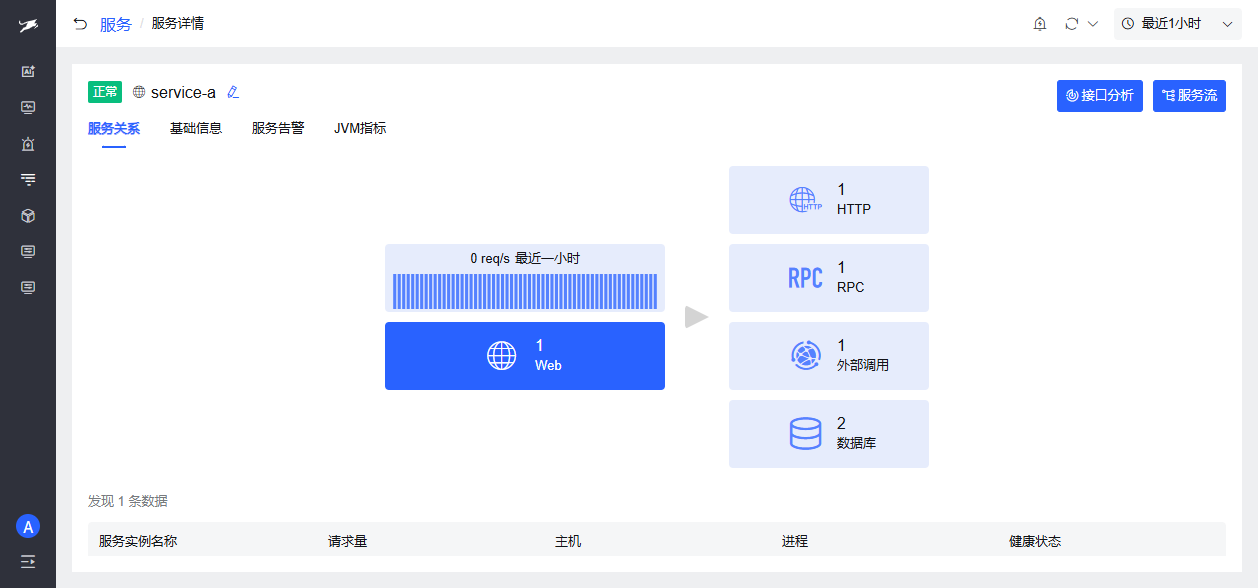
Fig. 3 · Service detail shows HTTP / RPC / database / MQ upstream-downstream and instance health—comparable to SkyWalking service-level APM drill-down
Fig. 3 · Service detail shows HTTP / RPC / database / MQ upstream-downstream and instance health—comparable to SkyWalking service-level APM drill-down
◆ ◆ ◆
5Eight-Dimension Comparison Matrix (Quick Reference)
Summarizes the above for direct use in technical reviews
| # | Dimension | DataBuff | SkyWalking |
|---|---|---|---|
| 1 | Protocol (OTLP) | Native sole standard; 4317/4318 | Supported multi-format coexistence; 11800/12800 |
| 2 | Architecture complexity | Minimal 3 core components | Medium-high Probe+OAP+Storage+UI |
| 3 | AI capabilities | AI native multi-agent + MCP | ML pipeline baseline/URI recognition |
| 4 | Deployment | Minimal single-command Docker / K8s script | Multiple combinations; Helm / binary |
| 5 | Distributed tracing | Yes Trace + topology + slow requests | Yes core strength + Mesh/eBPF |
| 6 | Core APM data plane | Trace+Metric topology and metric drill-down | Four pillars Trace/Metrics/Logs/Events |
| 7 | LLM Agent observability | Roadmap for AI applications | None |
| 8 | MCP / AI IDE integration | Native MCP | None official MCP |
◆ ◆ ◆
6Selection Guidance: Which Teams Fit DataBuff Better
Both are strong open-source APM options; if you are evaluating OTel unification and AI-native ops, DataBuff is often the lower-friction starting point
Company strategy is OpenTelemetry unified ingestion—app side maintains one OTel SDK/Collector You want minimal self-hosted APM: three components, 8G Demo, one-command deploy, dev self-ops You are exploring AI-native ops: conversational Trace/metric queries, multi-agent patrol, Cursor/Claude MCP workflows You are evaluating migration from SkyWalking—DataBuff supports Remote MCP to SkyWalking for parallel coexistence Small/medium teams want a minute-level POC to validate distributed tracing and AI Q&A before scaling
You must cover Trace + Metrics + Logs + Events in one pass with existing ES / BanyanDB ops Heavy reliance on Service Mesh (Istio/Envoy) or eBPF K8s monitoring for zero-code infrastructure coverage Deeply bound to SkyWalking Agent with stability of legacy systems as top priority
| Typical Scenario | Lean Toward | Core Rationale |
|---|---|---|
| OTel unified strategy + AI ops innovation | DataBuff | OTLP native · AI multi-agent · MCP openness · three-component deploy |
| Small/medium team · quick open-source APM validation | DataBuff | Three components · one-line deploy · 8G runnable |
| SkyWalking legacy · gradual OTel migration | DataBuff + parallel | OTel ingestion + Remote MCP reads SkyWalking during transition |
| Finance/government · four pillars + Mesh/eBPF | SkyWalking | Mature four pillars · zero-code infrastructure coverage |
| Large-scale Java · deep bytecode tracing | SkyWalking | Mature Agent · Mesh/eBPF supplement |
◆ ◆ ◆
7FAQ
| Question | Short Answer |
|---|---|
| Does SkyWalking still support OTLP? | Yes for Trace/Metrics OTLP ingestion; default ports differ from OTel ecosystem 4317/4318—check official docs at deploy time. |
| Must DataBuff replace SkyWalking? | No. Recommended: parallel POC—OTLP to DataBuff, legacy on SkyWalking, Remote MCP for transition reads. |
| What to check first for distributed tracing selection? | Protocol unification (OTLP), operational surface (three components vs four layers), and need for AI Q&A/MCP. |
◆ ◆ ◆
From an industry perspective, Gartner observability platform research notes that most products include APM, but APM alone no longer covers enterprise observability needs. When comparing SkyWalking and DataBuff, weigh OTel unified ingestion, component operational surface, and AI analysis depth as "platform evolution direction"—not just whether Traces are queryable.
◆ ◆ ◆
8References
[1] : https://skywalking.apache.org/docs/main/latest/en/concepts-and-designs/overview/ [2] : https://github.com/databufflabs/databuff?utm_source=article&utm_medium=web&utm_campaign=viral-02 [3] : https://skywalking.apache.org/docs/main/latest/en/setup/backend/otlp-trace/ [4] : https://github.com/apache/skywalking/pull/13826 [5] : https://skywalking.apache.org/docs/skywalking-banyandb/latest/concept/clustering/ [6] : https://databuff.ai/databuff/ai-apm-install.sh [7] : https://skywalking.apache.org/docs/main/next/en/setup/ai-pipeline/introduction/ [8] : https://skywalking.apache.org/ [9] : https://www.gartner.com/reviews/market/observability-platforms
◆ ◆ ◆
◆ ◆ ◆